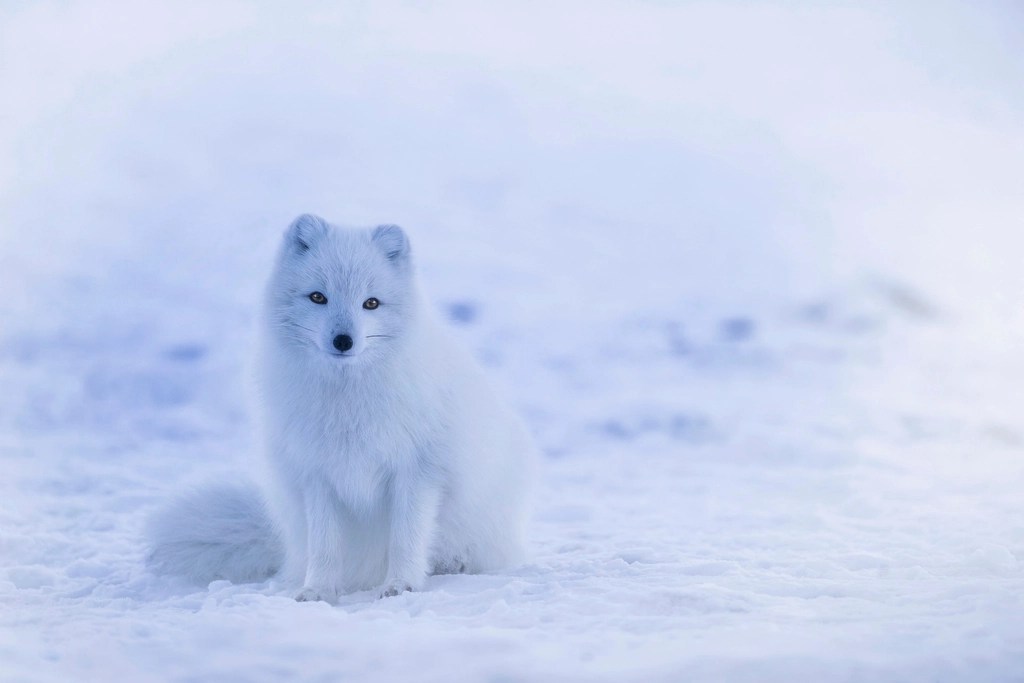
Species: Vulpes Lagopus
Genus: Vulpes
Conservation Status: Least Concern
General Overview:
The Arctic fox, also known as the white fox, polar fox or snow fox, is a species of fox native to the arctic regions of the Northern Hemisphere and are commonly found throughout the Arctic Tundra. Arctic foxes are highly adapted to cold environments, they have thick and warm fur, and a distinctive large and fluffy tail. They generally range from 56-68cm, and possess a rounded body shape which allows them to conserve body heat. They are smaller than their Red fox counterpart, and will typically weigh between 2.9kg and 3.5kg, although there are some that have been recorded being as large as 9.4kg. The further north arctic foxes are found, the smaller they tend to be, and their tail is around 1/3rd the length of their entire body. They have a lifespan between 1-11 years.
Fur Coat
Arctic foxes shed twice a year, switching between their summer coat which is dark and short, and their winter coat, which is lighter, long, and thick. The winter coat is twice the length of their summer coat.
Arctic foxes have two genetically distinct colour morphs (white and blue). The white morph is typically brown with light brown/cream sides and belly in the summer; this becomes entirely white during the winter. The blue morph is typically black, brown or grey in the summer, and will lighten slightly during the winter. Arctic fox fur provides the best insulation of any mammal on earth.
Adaptations to the cold
Arctic foxes have a multilayered winter coat, 70% of this is fine underfur, which provides exemplary insulation. They also have a low surface area to volume ratio; they have a compact body shape, short muzzle, legs, and ears. This allows for less heat to escape from their bodies.
They lose the most heat through their nose, ears, legs and feet, which is useful in the summer. These foxes also possess a dog-like mechanism in their nose, in which there is evaporative cooling, allowing them to keep their brain cool when necessary. Arctic foxes lose heat 11% slower than red foxes.
They prevent heat loss by tucking themselves tightly into a ball with their legs and head under their body, protected by their furry tail. They do not hibernate, but attempt to preserve fat through minimal locomotor activity.
Senses
Arctic foxes have a functional hearing range between 125Hz and 15lHz. Their hearing is less sensitive than the dog and the kit fox. Arctic foxes are able to hear lemmings under 4-5 inches of snow, and they reach this prey by pouncing through the snow to catch their prey.
They also have an exceptional sense of smell, they can smell small carcasses that are often left by polar bears up to 40km away. They are able to track frozen lemmings under 77cm of snow.
Reproduction
Arctic foxes begin to look for a home for their potential offspring in Spring, they live in large dens in frost-free, slightly raised ground. They tend to select dens which are easily accessible through many entrances, and build the den so that it faces southward toward the sun, allowing for a warmer den. They like the den to be maze-like, so as to confuse potential predators, and for quick escape in the event of red foxes being nearby.
Breeding typically takes place in April and May, the gestation period is around 52 days. Foxes give birth to pups in Spring or early summer, and their litter can span from 3-25 pips, which is the largest size in the order Carnivora.
Lifespan ranges from 3-4 years, although some can reach as old as 11. The oldest recorded Arctic fox was 16 years of age, in captivity.
Diet
Given the circumstances that they live in, Arctic foxes eat any small animal that is available to them, such as lemmings, voles, hares, birds, eggs, fish and carrion, They will scavenge on carcasses left behind by larger predators like polar bears and wolves, and in times of scarcity, eat their own faeces. Typically, lemmings are their main source of food.
Predators
Predators of Arctic foxes include large birds of prey, fellow carnivorians such as wolves, brown bears, or polar bears, and their cousins, the red fox.
Taxonomy
Vulpes lagopus is a ‘true fox’ belonging to the Vulpes genus, which consists of 12 extant species. They are classified as a Canidae.
Subspecies
- Bering Islands Arctic fox (Vulpes Lagopus beringensis)
- Greenland Arctic Fox (Vulpes Lagopus foragoapusis)
- Iceland Arctic Fox (Vulpes Lagopus Fuliginosus)
- Pribilof Islands Arctic fox (Vulpes Lagopus pribilofensis)
Conservation Status
The IUCN has placed Arctic foxes as being of the least concern in regard to extinction since 2004. However, the Scandinavian mainland population is endangered, despite legal protection from hunting. In Finland, the Arctic fox is classified as a critically endangered animal.

