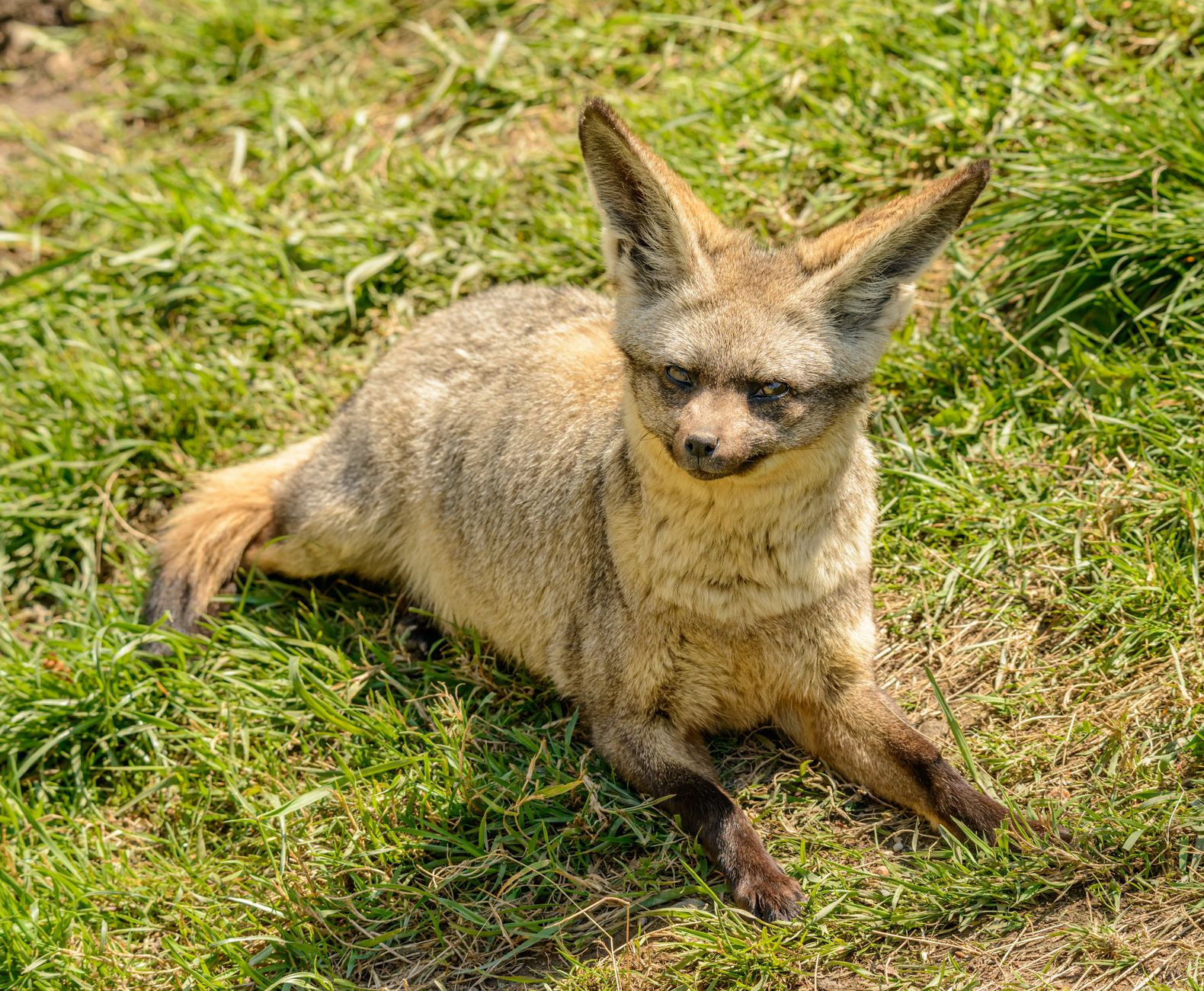
Species: Otocyon megalotis
Genus: Otocyon
Conservation Status: Least Concern
General Overview:
The bat-eared fox (Otocyon megalotis) is a species of fox found on the African savanna. It is the only extant species of the genus Otocyon, and is a sister species to all members of the tribe Vulpini (i.e red fox). Bat-eared foxes are not genetically a true fox.
It is named for its large ears, which have a role in thermoregulation. It is a small canid, being of comparable size to the closely related cape fox. Its fur varies in colour depending on the subspecies, but is generally tan-coloured. The bat-eared fox is found in Southern and East Africa, although the two subspecies are separated. In its range, the fox digs dens for shelter and to raise its young, and lives in social groups or pairs that hunt and groom together. No major threats to the bat-eared fox exist, and they are a least-concern species.
Taxonomy
The bat-eared fox is the only living species of the genus Otocyon. This is due to their large ears and different dental formula, which distinguishes them from being a Canid, and a true fox (Vulpes). the bat-eared fox was placed in a distinct subfamily of canids, Otocyoninae, as no relationship to any living species of canid could be established.
Subspecies:
There are two recognised subspecies of the bat-eared fox:
- Otocyon megalotis megalotis (Southern Africa)
- Otocyon megalotis virgatus (East Africa)
Description
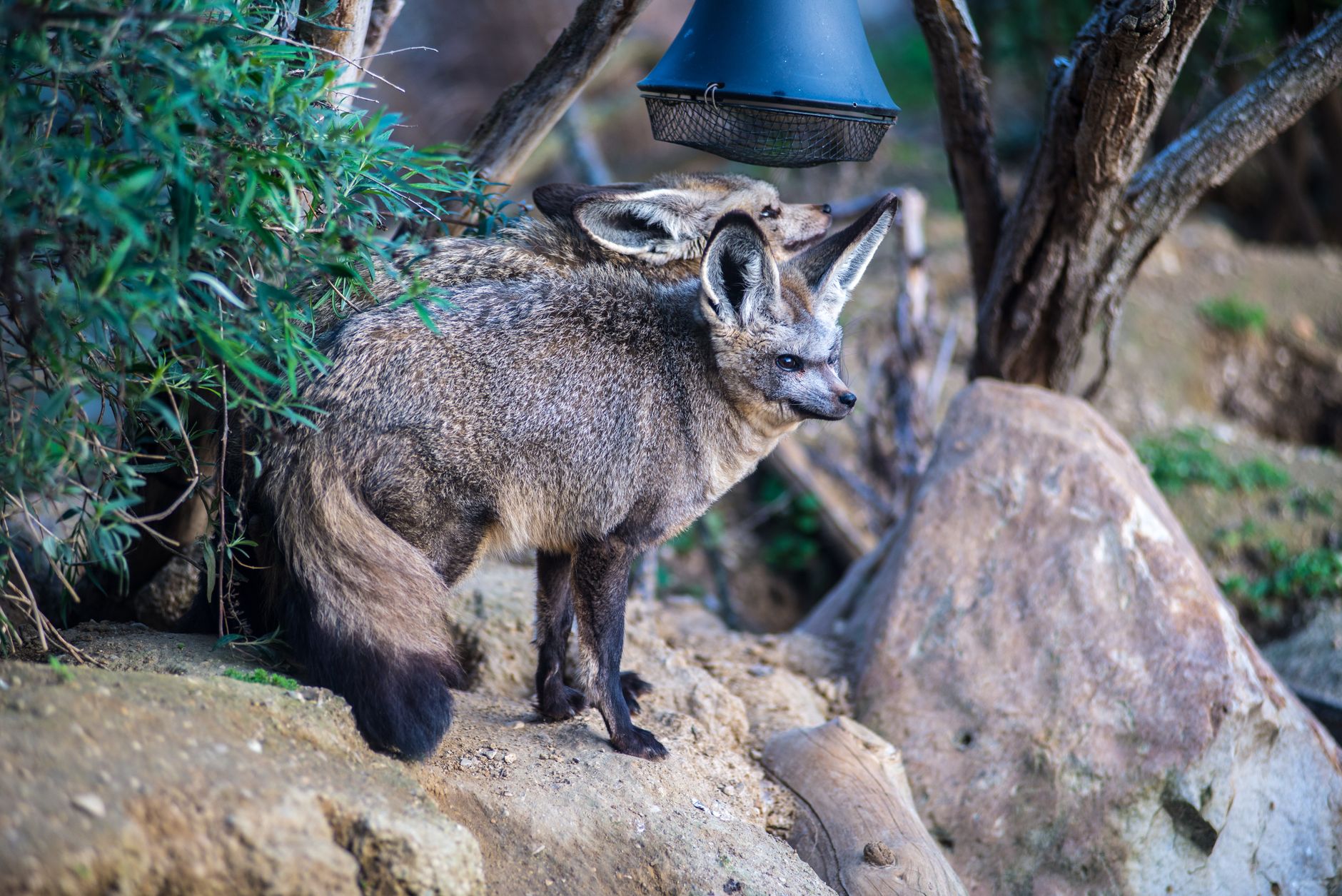
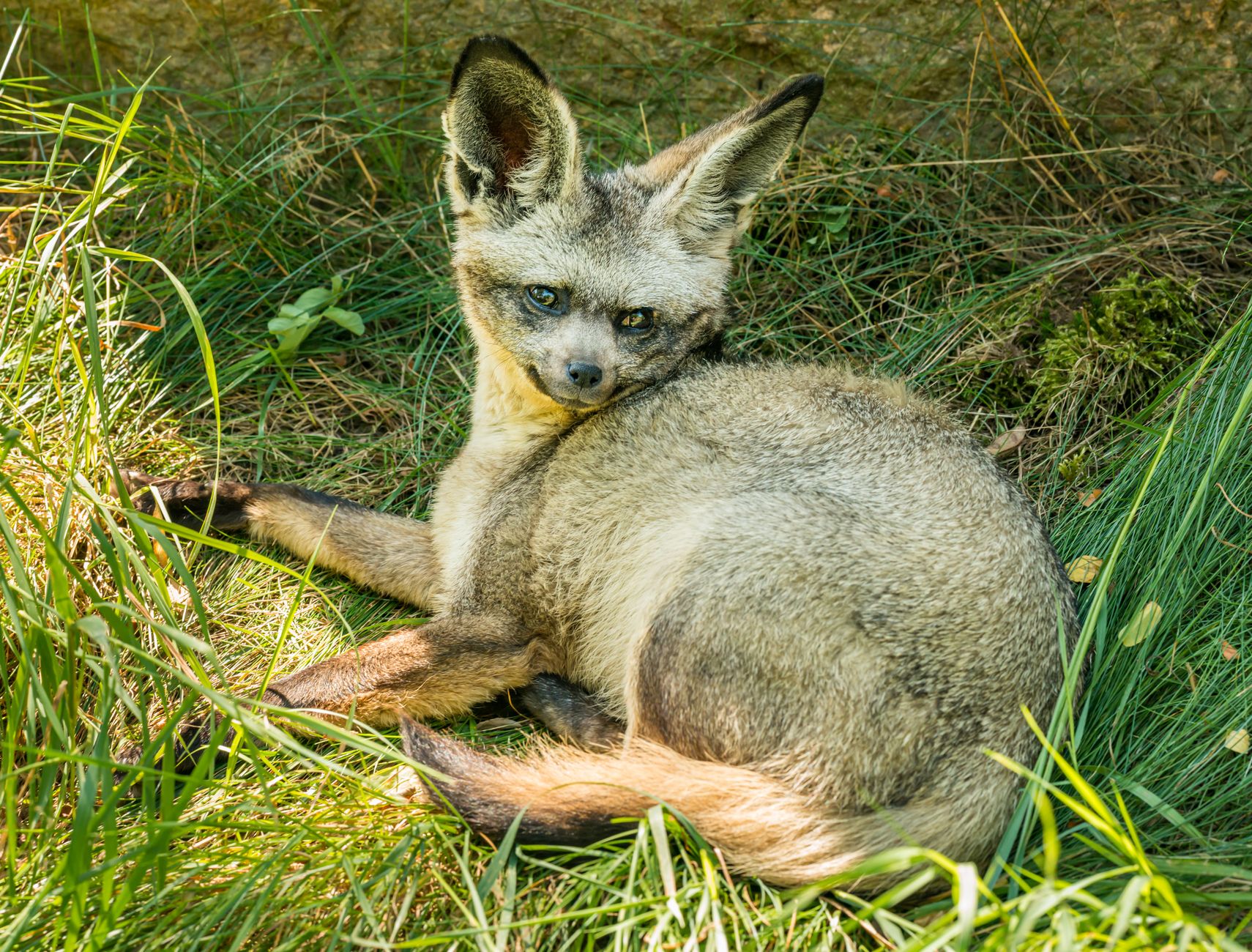
Bat-eared foxes range in weight from 3-5.3kg. They have notably large ears which are 4.3-5.1 inches long. The species displays a degree of sexual dimorphism, in that females are generally larger and heavier than males.
Their proportionally large ears are a characteristic shared by many other inhabitants in hot and arid climates such as the fennec fox. This allows them to distribute heat and locate prey effectively. The teeth of the bat-eared fox are much smaller than those of other canid species.
Distribution:
The two subspecies found in East and Southern Africa are separated by 620 miles. The bat-eared foxes are adapted to arid or semi-arid environments; they are often found in short grasslands and the more arid regions of the savannas. They prefer bare ground and areas where the grass is kept short, they hunt in these areas. However, they also venture into areas with tall grass and thick shrubs to hide when threatened.
As well as using dens to raise their young, bat-eared foxes use self-dug dens for shelter from extreme temperatures and winds. In South Africa, they hide under Acacia trees to seek shade during the day.
Behaviour and ecology
Bat-eared foxes are social animals. They live in pairs or groups, depending on the subspecies. In southern Africa (ssp. megalotis), bat-eared foxes live in monogamous pairs with pups, while those in eastern Africa (ssp. virgatus) may live in pairs, or in stable family groups consisting of a male and up to three closely related females with pups. Individuals forage, play, and rest together in a group, which helps in protection against predators. They engage in frequent and extended allogrooming sessions, which serve to strengthen group cohesion, mostly between mature adults, but also between young adults and mature adults.
Visual displays are important in communication among these foxes. When they are looking intently at something, the head is held high, eyes are open, ears are erect and facing forward, and the mouth is closed. When an individual is in threat or showing submission, the ears are pulled back and lying against the head and the head is low. The tail also plays a role in communication. When an individual is asserting dominance or aggression, feeling threatened, playing, or being sexually aroused, the tail is arched in an inverted U shape. In more northern areas of its range, they are nocturnal around 85% of the time. But in and around South Africa, they are only nocturnal during the summer.
Hunting and diet
The bat-eared fox is the only truly insectivorous canid; it prefers harvester termites which can constitute 80-90% of its diet. When this particular type of termite is not available, their opportunistic diet allows a wide variety of food items to be taken such as: other species of termites, arthropods, and rarely birds, birds’ eggs and chicks. They also consume berries, seeds, and wild fruit.
Reproduction and life cycle
In contrast to other canids, the bat-eared fox has a reversal in parental roles, with the male taking on the majority of the parental care behaviour. Gestation lasts for 60–70 days and females give birth to litters consisting of one to six pups. Beyond lactation, which lasts 14 to 15 weeks, males take over grooming, defending, huddling, chaperoning, and carrying the young between den sites. Additionally, male care and den attendance rates have been shown to have a direct correlation with pup survival rates. The female forages for food, which she uses to maintain milk production, on which the pups heavily depend.
Threats
Predators to the bat-eared fox are mostly large mammalian carnivores, but they are also prey to large raptors and the Central African rock python. Black-backed jackals pose the greatest threat to young bat-eared foxes, but in breeding areas, adults will engage in mobbing behavior to drive them off.

