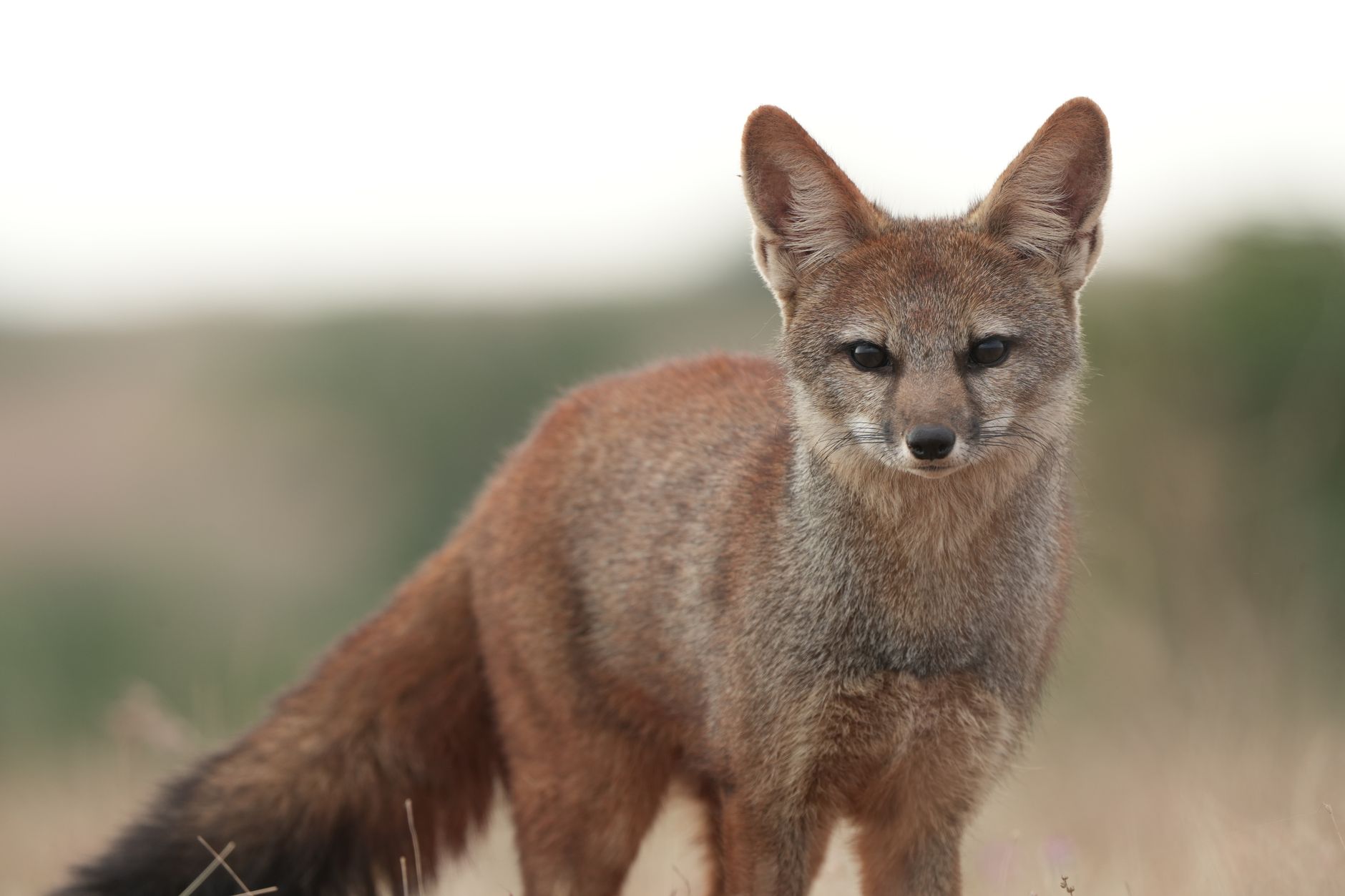
Species: Vulpes Bengalensis
Genus: Vulpes
Conservation Status: Least Concern
General Overview
The Bengal Fox (Vulpes bengalensis) is a fox endemic to the Indian subcontinent from the Himalayan foothills, through southern India, southeastern and eastern Pakistan and India, and southeastern Bangladesh.
Description
The Bengal fox is a relatively small fox with an elongated muzzle, long, pointed ears, and a long, bushy tail. There is an extensive variation in coat colour across populations and seasonally within populations, but generally, Bengal foxes have a reddish coat with paler sides and rufous limbs. They have a bushy, black-tipped tail, which is around 50-60% the length of their head and body. Males weigh 2.7-3.6kg and females weigh under 1.8kg.
Distribution and Habitat
The Bengal fox is endemic to the Indian subcontinent, ranging from the Himalayan foothills and Terai of Nepal through Southern India, and from southern and eastern Pakistan to eastern India and southeastern Bangladesh. Bengal foxes tend to avoid dense forests, steep terrain, grasslands and true deserts. They prefer flat land, bush and short grassland habitats.
Behaviour and ecology
Bengal foxes are predominantly crepuscular and nocturnal; while individuals may sometimes become active during cool periods of daytime, they typically spend warmer daylight hours under vegetation or in subterranean dens. They use three distinct types of den: basic, compact dens with two openings used for short rest periods, complex dens with multiple openings, and dens under rocks or rock crevices. Bengal foxes can sometimes be more social. Female Bengal foxes were reported to share dens during lactation and four adult foxes were seen emerging from the same den.
Bengal foxes are not especially suspicious of humans and can be found near human habitation. They are easy to tame.
Diet
Bengal foxes are omnivorous and opportunistic feeders. They feed primarily on insects, small mammals, reptiles, small birds, and fruits. Similarly to the red fox, they are a predator of eggs.
Communication
Bengal foxes make a wide range of vocalisations. A common sound is their “chattering cry”. This sound seems to have a significant role in establishing territory and may also be used as a warning call, They also growl, whimper, whine, and make a sound which could be called a growl-bark.
Reproduction
During the breeding season, males vocalize intensely during the night and at dusk and dawn. Throughout most of its range, the mating season occurs in December to January and after a gestation period of around 50–53 days, two to four pups are born in a den. Both parents participate in pup-rearing and protection. Aggregations of grown foxes at den sites have been recorded when the dispersal has been delayed, although the presence of helpers has not been observed. Pups may sometimes be nursed by multiple females, but the relationship between them is uncertain.
During the day, they tend to rest under shrubs and bushes, except in summer when they rest in dens. Play between pups is typical during the first 3 months and consists of vertical jumps, back arching, foreleg stabs, submissive displays, and play solicitation; the adult male sometimes plays with the young.
Threats and conservation
The main threat posed to Bengal foxes is a lack of habitat protection. Their habitat is continually being reduced, and they are also threatened by hunting for their fur, and body parts for traditional medicine. However, they are listed as least concern in the IUCN Red List of Threatened Species.

