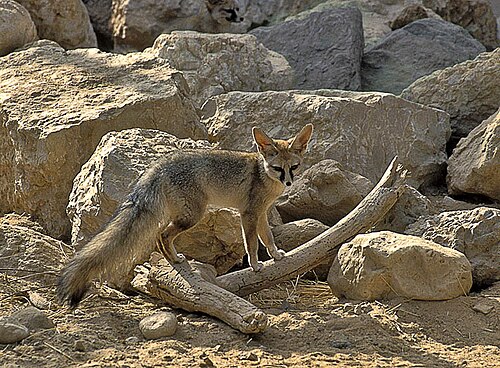
Species: Vulpes Cana
Genus: Vulpes
Conservation Status: Least Concern
General Overview
Blanford’s fox (Vulpes cana) is a small fox native to the United Arab Emirates, Oman, Yemen, Saudi Arabia, Afghanistan, Pakistan, and Palestine.. It is listed as Least Concern on the IUCN Red List.
Description
Blanford’s fox is a small fox with wide ears and a long bushy tail, which is nearly equal to the length of its body. Size varies geographically; Afghan-Iranian Blanford’s foxes tend to be larger than their Oman counterparts. Among all extant canids, only the fennec fox is smaller than Blanford’s.
The body is brownish-grey, fading to a light yellow on the belly. Their winter coat is soft and woolly, with a dense black undercoat and white fur speckles in their dorsal area. They also have a thick layer of fat, which serves as thermal insulation in cold and dry winter. Their summer coat is less thick, with paler fur and less noticeable white hair. The tip of their tail is normally black, but can be white in some individuals.
Similarly to other arid land foxes such as the bat-eared fox and fennec fox, the Blanford’s fox has a characteristically large ear is an adaptation to enhance heat dissipation. It does not have pads covered with hair unlike other desert foxes, and cat-like, sharp, curved, semi-retractile claws.
The Blanford’s fox can climb rocks and make jumps described as “astonishing”; they can jump to ledges 9.8 feet above them with ease. The foxes use their sharp curved claws and naked footpads for traction on narrow ledges and their long, bushy tails act as a counterbalance.
Distribution and Habitat
The Blanford’s fox has a rather discontinuous range. Confirmed records exist in Palestine, the Sinai Peninsula, Jordan, Saudi Arabia, Oman, and the United Arab Emirates, in areas such as Jebel Hafeet and the Western Hajar Mountains of Ras Al Khaimah. They have also been spotted in western Yemen.
Behaviour and Ecology
The Blanford’s fox is strictly nocturnal. This is an activity pattern which is an anti-predator response to diurnal raptors.
They are omnivorous and primarily insectivorous and frugivorous. They consume fruits and material of date palms. In Pakistan, they feed on Russian olives, melons, and grapes.
Blanford’s foxes are usually solitary foragers, only foraging in pairs on occasion. Unlike other fox species, it seldom caches food.
Reproduction
Gestation period is around 50–60 days, and litter size is one to three. The lactation period is 30–45 days. Neonates are born with soft, black fur, with an estimated body mass of 29 g. At the age of two months, the kits start to forage with one of the parents, and at 3 months of age they begin to forage on their own. Juveniles have similar markings as adults, but their fur is darker and more grayish. Sexual maturity is reached at the age of 10–12 months.
Average lifespan of Blanford’s foxes is 4 to 5 years, and does not exceed 10 years in the wild.
Conservation
The IUCN categorises Blanford’s fox as “least concern”. In Oman and Yemen, they are a protected species from hunting.

