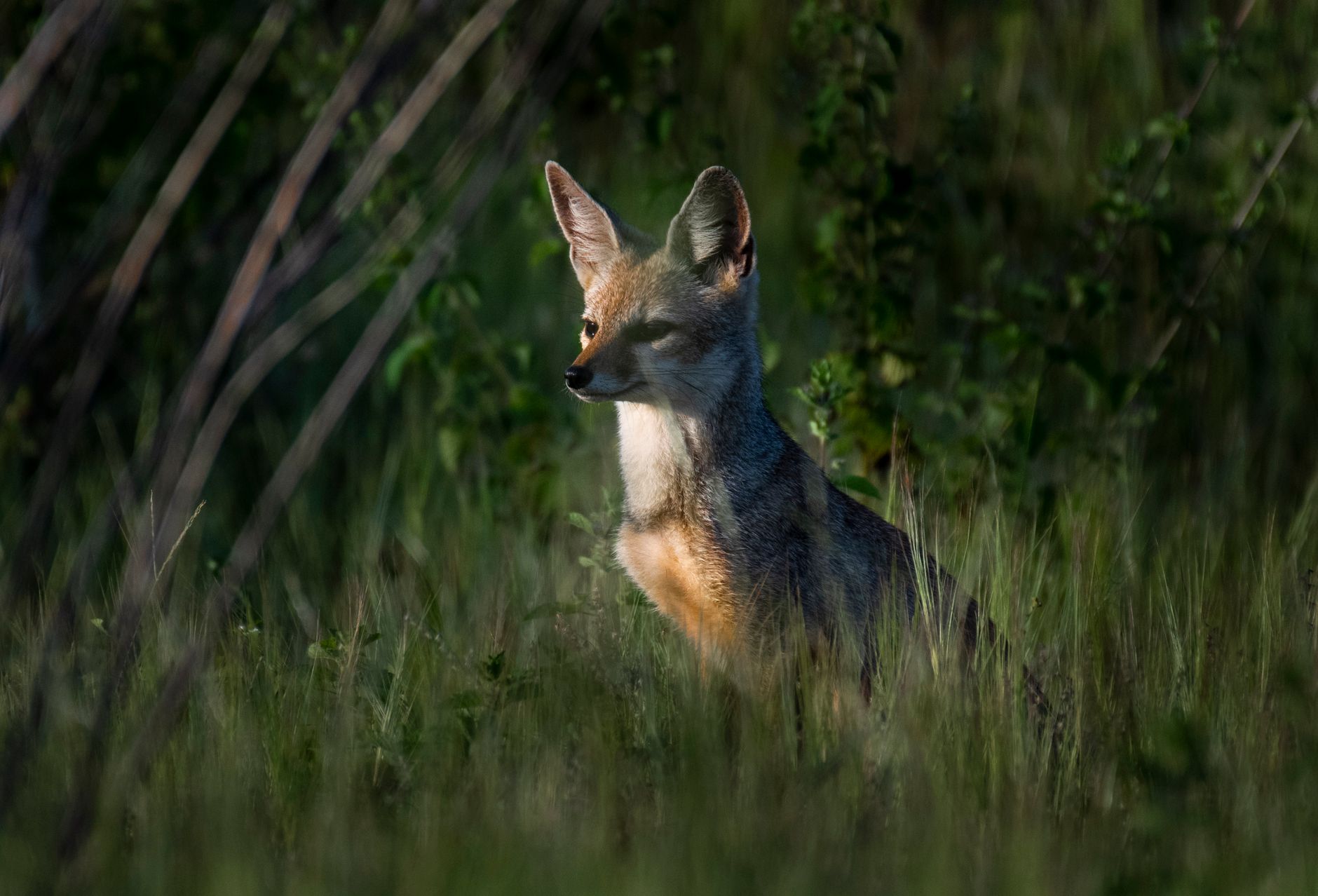
Species: Vulpes Chama
Genus: Vulpes
Conservation Status: Least Concern
General Overview
The Cape (Vulpes chama) is a small species of fox, native to southern Africa. It is the only “true fox” present in sub-Saharan Africa.
Description
Vulpes chama is a small-built canid, usually measuring 45-62 cm long, not including its tail which is typically 30 to 40 cm. They have a very similar skill to the Bengal fox, although they have a larger cranium.
They have relatively large and sharp ears. Pelage colour is silvery gray, tawny at the back of the ears, with white hairs appearing arounf the side of the pinna in the center. The colour of their neck and sides is lighter, and the underparts are pale tawny to pale buff. They have a dull red colour on their head, and their lower jaw is dark brown. The tail tip is always black. The cape fox presents little to no sexual dimorphism.
Distribution and Habitat
Cape fox is the only species of the genus Vulpes that exists in Africa south of the equator. They mainly occupy arid and semi-arid areas, but in some sections, they also inhabit areas of higher rainfall and denser vegetation. The species is widespread in Zimbabwe, Botswana and South Africa, as well as appearing in Lesotho.
Behaviour
The Cape fox is nocturnal, and is mostly active before dawn or after dusk. They can be spotted during early mornings and evenings. In the day, they typically shelter in underground burrows, holes, or dense thickets. They are active diggers that can excavate their own burrow, although they can also modify a burrow of another species to suit their requirements.
They are mostly solitary, despite forming mated pairs. Occasionally, they will gather in loose groups to feed.
They are normally a silent fox, although they are known to communicate with soft calls, whines, and chirps. When alarmed, the Cape fox will utter a loud bark. When aggressive, they are known to growl and spit at their attacker. To show excitement, the fox lifts its tail ; the height of the tail indicates the level of excitement.
Diet
Cape foxes are completely omnivorous and opportunists, feeding mainly on small mammals such as rodents and insects. Thet also eat birds, small reptiles, carrion and fruits. They have also been reported to kill livestock, such as young lambs.
Reproduction
The female Cape fox has a gestation period of 51 to 53 days and gives birth to a litter of one to six cubs (or kits). They typically weigh from 50 to 100 g (1.8 to 3.5 oz) at birth. Reared underground in burrows, the cubs stay close to the den until they are about four months old. Several females may also share simultaneously the same den. The cubs are weaned around six to eight weeks of age, but do not begin to forage until they are four months old and often play outside during daylight hours.[10] Both parents care for the young, with the male also providing food to the female for at least 1–2 weeks postpartum. Cubs usually become independent at 5–11.5 months of age, when they disperse (typically in June or July). The Cape fox has a life expectancy of about six years, but can live for up to 10 years.
Conservation
They also often succumb to diseases such as rabies and canine distemper, and many Cape foxes are killed on the road by vehicles. Many are hunted and persecuted as vermin. About 2,500 individuals are killed yearly; which is approximately 16% of the population. Nonetheless, populations of V. chama are currently stable across their entire geographic range.

