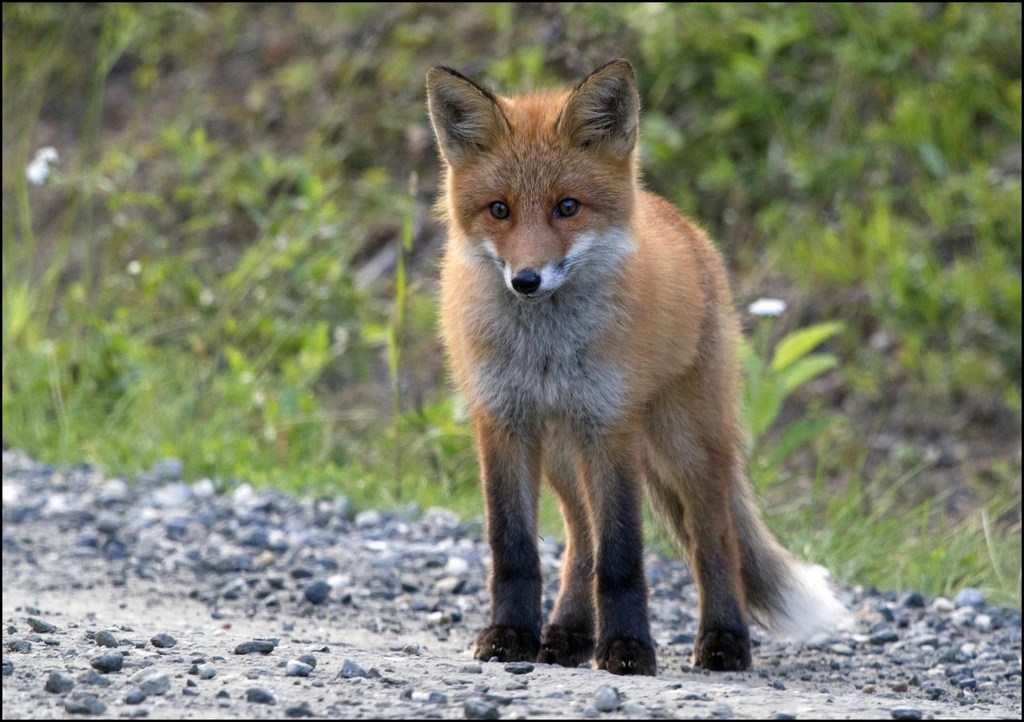
Species: Vulpes Vulpes
Genus: Vulpes
Conservation Status: Least Concern
General Overview
The red fox (Vulpes Vulpes) is the largest of the true fox species, and the most widely distributed member of the order Carnivora. Red foxes are found across the entire Northern Hemisphere, as well as parts of North Africa. They typically prey on small rodents, and have expanded beyond their initial range, being introduced to Australia in the 19th Century.
Red foxes originated in Eurasia around 400,000 years ago and reached North America around 130,000 years ago. They are incredibly adept at adapting to new environments, distinguishing them from other fox species. Despite being called the red fox, Vulpes Vulpes often produces individuals with other fur colourings. 45 subspecies of the red fox are currently recognised, and can be divided into two categories: large northern foxes, and small basal southern grey desert foxes, which are found in Asia and North Africa.
Red foxes have a long history of association with humans; they pose little threat and are beginning to undergo domestication due to food scarcity in urban areas. This domestication is largely complete in Russia through the domesticated silver fox.
Description
The red fox has an elongated body and relatively short limbs. Their tail is longer than half their body length; it is fluffy, and reaches the ground when they are in a standing position. They have oval pupils. They have 5 digits on their forepaws, and 4 on their hind feet. Red foxes are very agile, they can jump over 2 m high fences, and are able to swim well.
Red foxes have narrow and elongated skulls. There is sexual dimorphism; female red foxes tend to have smaller skulls than males, wider nasal regions, hard palates, and larger canines.
Red foxes are the largest species of the true fox (Vulpes) genus. However, they are much lighter than similarly sized dogs, typically weighing between 2.2-14kg on average. There is also geographical variation: American red foxes are lighter, and longer, whilst British red foxes are heavily built and shorter.
Fur
In the winter, red foxes have a dense, soft, silky and long coat. For Northern variations, the fur is very long, dense and fluffy, but it is shorter and sparser in Southern forms. North American varieties typically have the silkiest guard hairs, whilst most Eurasian red foxes have coarser fur.
The fur on areas such as the head and lower legs are known as “thermal windows”. These are kept short and dense all year round. There are three main colour morphs; red, silver/black and cross.
Senses
Red foxes have binocular vision, their sight reacts mainly to movement. They have acute auditory perception, being able to hear crows flying at 0.25-o.5km and mice squeaking at about 330 ft. They have a good sense of smell, but it is weaker than that of dogs specialised in scent work.
Distribution and habitat
Red foxes are the most widespread member of the order Carnivora, being found on every continent aside from South America and Antarctica.
Behaviour and Ecology
Red foxes either establish stable home ranges within particular areas, or are itinerant with no fixed abode. They use urine to mark their territories; males raise one of their hind legs, spraying this in front of them, whilst females squat down and spray their urine onto the ground behind them. Red foxes also use urine to mark empty cache sites where found food is stored, allowing their areas to be easily found, so as to not waste time investigating them.
Red foxes live in family groups that share a territory.
Reproduction and Development
Red foxes reproduce once a year in spring. The gestation period lasts 49-58 days. The average litter consists of four to six kits, though litters of up to 12 kits have been reported. Kits are born blind, death and toothless, with dark brown fluffy fur. Mothers remain with their kits for 2-3 weeks as they are unable to thermoregulate. During this period, the fathers or barren vixens feed the mothers. Vixens are very protective of their kits, and have been known to fight off animals as large as terriers in their defence. If the mother dies before the kits are independent, the father will take over. In captivity, the longevity of red foxes can be up to 15 years, though in the wild, they usually do not make it past 5.
Denning behaviour
Outside of the breeding season, red foxes usually prefer to live in open, densely vegetated areas, although they may enter burrows to escape bad weather. They often dig their burrows on hill or mountain slopes, ravines, steep riverbanks, as well as ditches, depressions and gutters. They prefer to dig their burrows in well-drained soil. Compared to burrows constructed by Arctic foxes, badgers, marmots and corsac foxes, red fox dens are not overly complex. The average sleep time of a red fox is 9.8 hours a day.
Communication
Red foxes communicate through movements of their ears and tail, as well as postures. Certain body markings emphasise certain gestures. These postures can be categorised as either aggressive/dominant or fearful/submissive. In some cases, these postures are blended. Inquisitive foxes will rotate and flick their ears while they sniff. Playful individuals perk their ears up and stand on their hind legs. Male foxes will turn their ears outward and raise their tails horizontally with the tips raised upward when courting females or after successfully evicting intruders. When afraid, red foxes grin in submission, arching their backs, curving their bodies, crouching their legs and lashing their tails back and forth with their ears pointing backwards and pressed against their skulls. When merely expressing submission to a dominant animal, they adopt a similar posture, but without arching their backs or curving their bodies. Submissive foxes approach dominant animals with their muzzles reaching up in greeting, in a low posture. When two evenly matched foxes confront each other over food, they approach side by side and push against each other’s flanks. They betray a mixture of fear and aggression through their actions: they lash their tails and arch their backs, but do not crouch or pull their ears back and flatten them against their skulls. When launching an assertive attack, red foxes approach directly, with their tails held high and their ears rotated sideways. During such fights, red foxes will stand on each other’s upper bodies with their forelegs, using open-mouthed threats. Such fights typically only occur among juveniles or adults of the same sex.
Red foxes have a wide vocal range, being able to produce different sounds spanning 5 octaves which blend into each other. Most of these sounds can be divided into two categories:
- Contact calls: The most commonly heard contact call is a barking sound consisting of three to five syllables, transcribed as “wow wow wow”, which is often made by two foxes approaching one another
- Interaction calls: When greeting one another, red foxes emit high pitched whines, particularly submissive animals. A submissive fox approached by a dominant animal will emit a ululating siren-like shriek.
There is another call which does not fit into these two categories; a long, drawn-out, monosyllabic “waaaaah” sound. As it is commonly heard during the breeding season, it is thought to be emitted by vixens summoning males. When danger is detected, foxes emit a monosyllabic bark. At close quarters, it is a muffled cough, while at long distances it is sharper. Kits make warbling whimpers when nursing, these calls being especially loud when they are dissatisfied.
Diet and hunting
The red fox is an omnivore, and they have a highly varied diet. They consume over 300 animal species, including small rodents such as mice, ground squirrels, hamsters, porcupines and raccoons. They also eat berries such as blueberries, blackberries, raspberries, cherries, and apples.
Competitors
The red fox typically dominates other foxes. This is seen in the relationship between arctic foxes (Vulpes lagopus) and red foxes. Both species kill each other’s kits, given the opportunity. There are also recorded instances of red foxes killing and eating arctic foxes.
The red fox is a competitor of the corsac fox, they hunt the same prey all year. The red fox is stronger, and better adapted to hunting in snow, as well as in hunting and catching medium to large rodents. The red fox dominates kit and swift foxes. However, the gray fox dominates the red fox wherever their ranges meet.
Hunting and persecution
Red foxes are still widely persecuted as pests, with human-caused deaths being a major source of mortality for the species. 400,000 – 425,000 foxes die in the UK alone every year; vehicles account for 25% of these deaths.
Urban foxes and domestication
particularly lower-density suburbs. In the UK, it is estimated that the number of urban foxes rose from 33,000 in 1995 to 150,000 by 2017.
Red foxes are most active at dusk and dawn, when they do most of their hunting and scavenging. They are seen rarely during the day. They can scavenge successfully in cities, eating anything that humans eat, and are opportunistic feeders, often being seen eating scraps of food from waste sites in London. As a result, many people will deliberately leave food out for them, which tends to attract the fox to one’s home.
It has been argued that foxes have been exhibiting friendlier behaviour to humans in urban areas. This may be due to multiple factors, such as a lack of natural prey to hunt, lack of food resources, and an increased attitude of feeding foxes. This domestication has been successful in Russia through the domesticated Russian silver fox.

